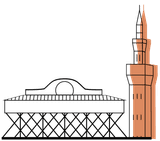


Opening of the West Marsh Paper Mills, Grimsby - 1906
Commemorative Banquet Menu
1 November 1906
This beautifully printed souvenir booklet was produced to commemorate the official opening of Peter Dixon & Son's West Marsh Paper Mills on 1 November 1906. Tied with a pale blue silk ribbon and featuring an illustration of the newly completed works, it was presented to invited guests attending the celebrations before the commemorative banquet at the Royal Hotel, Grimsby.
The construction of the West Marsh Paper Mills marked one of the most significant industrial developments in Edwardian Grimsby. Built alongside the docks, the site was ideally placed to receive imported Scandinavian timber and wood pulp before manufacturing high-quality newsprint and other papers for distribution throughout Britain. The new works were among the most modern paper mills in the country and were widely described at the time as the first new paper mill to be built in Britain for around twenty years.
The opening ceremony attracted national attention and was performed by Lord Northcliffe, proprietor of the Daily Mail, Daily Mirror and several other leading newspapers. His presence was especially fitting, as Britain's rapidly expanding newspaper industry relied upon an ever-increasing supply of quality paper. Over the following decades, the West Marsh Paper Mills became one of Grimsby's largest employers, providing work for around 1,000 people at their peak.
Following the official proceedings, guests enjoyed an elaborate banquet reflecting the influence of French haute cuisine on prestigious British dining during the Edwardian era. The menu offered an impressive succession of fish, meat, game and dessert courses, accompanied by fine wines including Beaune Burgundy and Perrier-Jouët 1898 Champagne. The complete menu is reproduced below with an English translation.
More than a century later, this rare souvenir provides a remarkable snapshot of Edwardian hospitality and culinary fashion. It not only commemorates the opening of one of Grimsby's most important industries but also captures the optimism, civic pride and confidence that accompanied the town's industrial expansion during the early twentieth century.
Banquet Menu
Original French
Consommé Royale Potage de Tête de Veau
Turbot. Sauce. Homard. Filet de Sole.
Ris de Veau Pique aux Truffes Crevettes à l'Indienne.
Filet de Boeuf. Selle de Pré Salé. Choux Bruxelles. Pomme Nature.
Faisan. Perdreaux Rôtis Salade.
Petit Fours. Crème au Noyeau. Gelée au Vin. Glacés.
Dessert. Café.
English Translation
Consommé Royale (clear beef broth with a savoury egg custard garnish) Calf's Head Soup
Turbot with sauce and Lobster Fillet of Sole
Larded Sweetbreads with Truffles Curried Prawns (Indian Style)
Fillet of Beef Saddle of Salt-Marsh Mutton Brussels Sprouts and Plain Boiled Potatoes
Pheasant Roast Partridges with Salad
Petit Fours (small fancy pastries) Noyeau Cream (a dessert flavoured with almond liqueur) Wine Jelly Ices
Dessert Coffee
Wines
Hock – Lauberheim
Burgundy – Beaune
Champagne – Perrier-Jouët, 1898
Perrier – Mineral Water
Whisky
Why is the menu in French?
During the late Victorian and Edwardian periods, French cuisine was regarded as the pinnacle of fine dining. At prestigious banquets throughout Britain it was customary for menus to be written almost entirely in French, regardless of where the meal was served. Doing so reflected elegance, sophistication and the influence of French culinary traditions. Although many guests may not have understood every term, the style itself conveyed the importance and prestige of the occasion.
From the collection of the Grimsby & Cleethorpes Museum.
Photo credit: © Grimsby & Cleethorpes Museum


